Live Intelligence · Earth · on the bench
The Moon
Computes the moon from Meeus and matched the Naval Observatory to the minute. It knows nothing of where you stand.
Scorecard · 18 of 20 checks met
How the checks workAll four: computed in the browser from Meeus; the map is NASA's, and credited.
All four: method, accuracy and omissions (libration, a geocentric view) are stated on the page.
All four: five phase instants matched USNO's to within a minute.
All four: no data feed; the map is bundled on the same origin.
Missed R3 (no rise, set or libration) and R4 (no export in our evidence).
01What it is
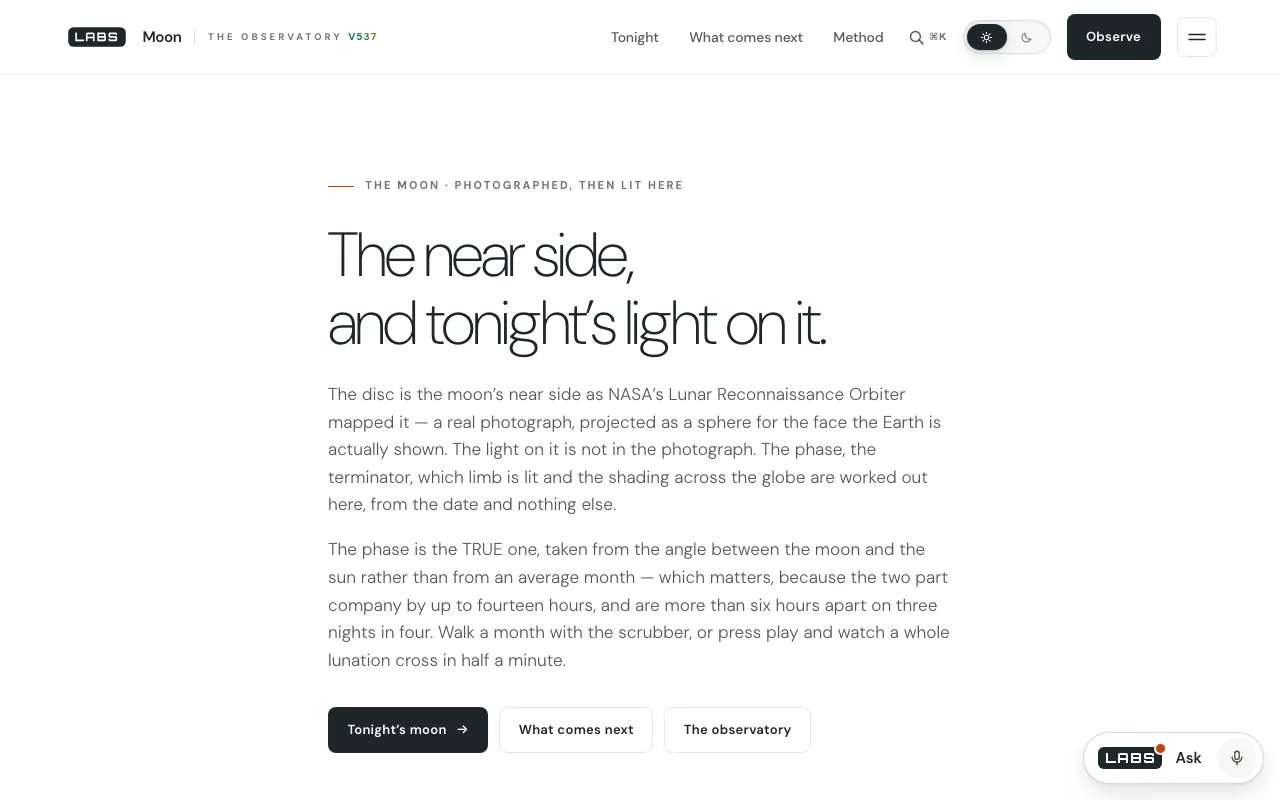
The Moon shows the moon for any moment, computed rather than looked up. It gives the true phase and the illuminated fraction, draws the terminator on the near side as NASA's Lunar Reconnaissance Orbiter mapped it, and reports distance, apparent size and where this month's perigee and apogee fall. Below sit the next four phases, a year of new and full moons with eclipses marked, and a scrubber that plays a whole lunation in thirty seconds.
It is for anyone who wants tonight's moon explained (photographers, walkers, teachers) and for readers who want to know how each figure was reached.
02How it works
There is no data feed. assets/js/moon-core.js implements Jean Meeus's Astronomical Algorithms, second edition: chapter 47 for the moon, chapter 25 for the sun, chapter 48 for the illuminated fraction (moon-core.js:29-34). The phase comes from the true angle between the computed moon and sun, not from a mean month; the source notes that the real moon runs up to about fourteen hours ahead of or behind the average (moon-core.js:18-27, 190-210).
Each phase instant is found by bisection (moon-core.js:228-248), and perigee and apogee are searched for rather than tabulated, so the closest-this-month line cannot go stale (moon.js:1114-1137). The disc is NASA SVS 4720's LRO albedo map, bundled on the same origin and projected orthographically; only the light on it is computed (moon.js:227-236).
03The test
On 27 September 2026 we loaded moon-core.js into JavaScriptCore, called the page's own functions for that moment and the phases around it, and set the answers beside the US Naval Observatory's phase service.
| UTC | What we did | What came back |
|---|---|---|
| 20:00:14Z | Page and assets on the local copy | HTTP 200, 57,791 bytes; the LRO map 214,153 bytes; moon-core.js 26,380 bytes. |
| 20:00:45Z | The page's astronomy, run headless | Waning gibbous, 98.32% lit, 16.69 days old, 375,418 km away, 31.82 arcmin across. |
| 20:00:45Z | Five phase instants from the page | Full 26 Sep 16:49:29; last quarter 3 Oct 13:25:52; new 10 Oct 15:50:38; first quarter 18 Oct 16:13:03; full 26 Oct 04:12:16 UTC. |
| 20:04:00Z | The same five from USNO's phase API | 16:49, 13:25, 15:50, 16:12, 04:12 UT: all five within one minute of the page. |
04The comparison
US Naval Observatory, Phases of the Moon
fetched 2026-09-27What it is
Official tables of the primary phases in Universal Time for 1700 to 2100, with illuminated-fraction tables and rise and set data.
What it does better
It is the national authority, and it gives moonrise and moonset for a place, which The Moon does not.
Where The Moon goes further
The Moon draws its answer: an LRO-mapped disc lit by the computed phase, terminator included (moon.js:199-236). It explains distance, apparent size and progress toward perigee, and states its own accuracy (moon.js:1163-1176, 1209-1213), a claim that held to the minute against USNO in our test.
NASA SVS, Moon Phase and Libration (Dial-a-Moon)
fetched 2026-09-27What it is
8,760 hourly renderings a year of the moon's size, orientation and illumination, with libration and distance data.
What it does better
It shows libration and the true orientation hour by hour, offers north-up and south-up views, and provides high-resolution frames to download.
Where The Moon goes further
The Moon computes any instant live instead of picking the nearest pre-rendered hour, and sets the next four phases, a year of new and full moons with eclipses, and a thirty-second lunation beside it (moon-core.js:190-248; moon.js:1218-1270, 1353).
Moon Giant, Moon Phase Today
fetched 2026-09-27What it is
A daily phase page with illumination, age, distance and a phase calendar.
What it does better
A month-grid calendar a reader can scan at a glance.
Where The Moon goes further
The Moon names its method and the accuracy of its figures (Meeus chapters, about ten arcseconds, about a minute); Moon Giant's page as fetched did not say how its figures are computed. It also places the moon between this month's perigee and apogee (moon.js:1114-1176).
05Where it falls short
- No moonrise or moonset, and no location at all. The view is geocentric (
moon.js:1211), so it cannot tell you when the moon will be up where you are; USNO can. - Libration is not modelled, so features near the limb are drawn where they sit on average rather than where they are tonight (
moon.js:1212-1213). NASA's Dial-a-Moon shows it hour by hour. - The disc is drawn north up only; NASA SVS offers both orientations.
06The ruling
This is one of the most thoroughly evidenced pages on the bench. The Moon carries its astronomy with it, says in the page how accurate that astronomy is, and, the part that matters, the claim survived an outside check: five phase times, five agreements with the US Naval Observatory within a minute. It even takes the trouble to call 'supermoon' what it is, a word coined by an astrologer in 1979 with no astronomical definition (moon.js:1205-1206).
Its gaps are the observer's: no place, no rise and set, no libration. Use it to understand tonight's moon; use USNO to plan when to see it.
On the docket: 18 of 20 checks met. Computes the moon from Meeus and matched the Naval Observatory to the minute; knows nothing of where you stand.