Live Intelligence · Internet · on the bench
Routing
A readable window on BGP whose count matched Hurricane Electric's exactly. No RPKI, and one source only.
Scorecard · 16 of 20 checks met
How the checks workAll four: RIPEstat is the RIPE NCC's own service, called direct, keyless, with no relay.
All four: method named; failures and gaps in the wire are said, not filled.
All four: its address count for AS15169 matched Hurricane Electric's exactly.
Missed F3 and F4: every lookup is a call to stat.ripe.net.
Missed R3 (no RPKI, IRR or exchange-point data) and R4 (no export in our evidence).
01What it is
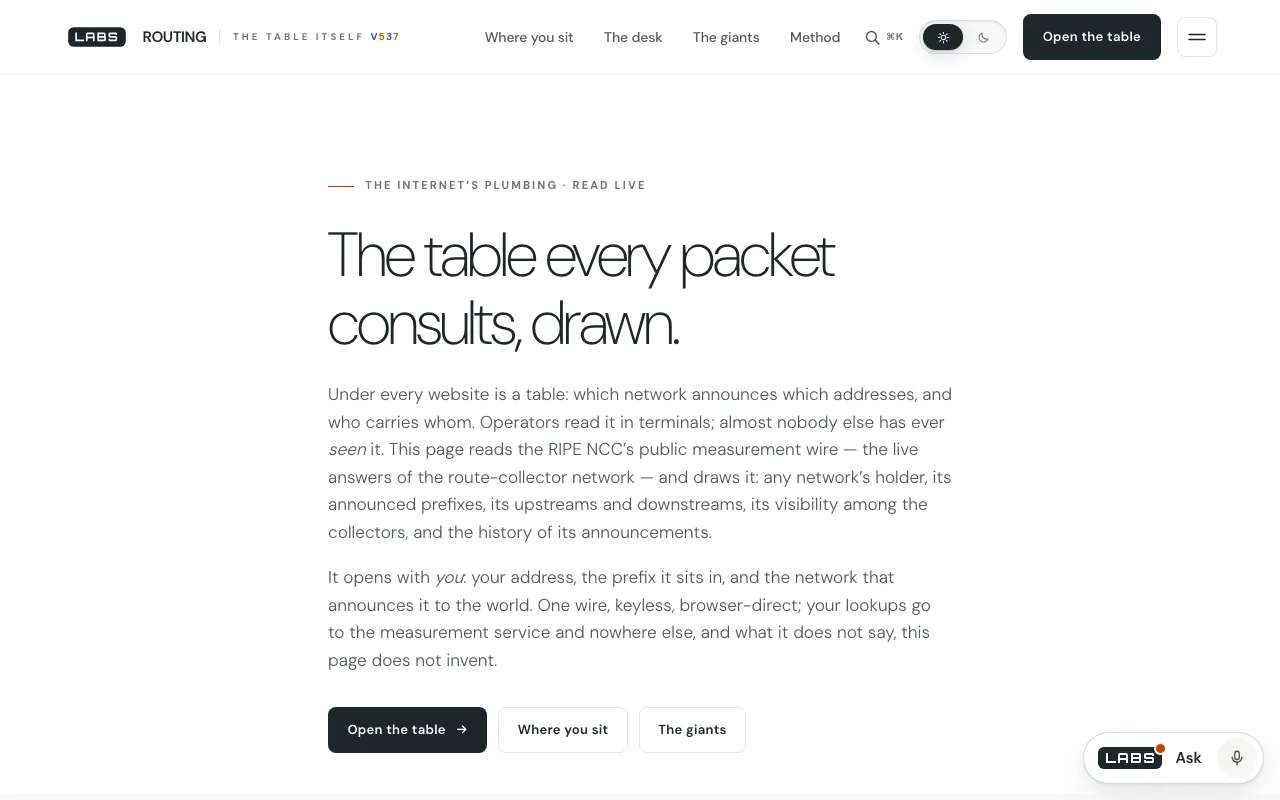
Routing is a plain-language window on the internet's routing table. Enter an AS number, a prefix or an IP address and it shows who holds it, what it announces, its upstream and downstream neighbours, how many of RIPE's route collectors can see it, and a drawing of its announcement history. It opens by showing where your own connection sits.
It is for curious non-specialists and people who work near networks (support staff, journalists, students) who want to see who is behind an address without learning BGP tooling.
02How it works
The browser talks straight to one public API: the RIPE NCC's RIPEstat Data API at stat.ripe.net, keyless and open to cross-origin reads, fed by the RIS route collectors (routing.js:1-10, 36). For a network it calls as-overview, routing-status, announced-prefixes, asn-neighbours and routing-history (routing.js:159-162, 261); for a prefix, prefix-overview, routing-status and rir (routing.js:313-315); for an address, network-info (routing.js:140); and whats-my-ip for yours (routing.js:80).
Each call has a fifteen-second deadline, so a hung request becomes a stated failure. The limit was set after the source recorded AS15169 answering in 0.31 s while AS13335 was still open at 45 s (routing.js:36-58). Named shortcuts cover networks people have heard of, from Cloudflare to Comcast, each with a one-line explanation (routing.js:363-369).
03The test
On 27 September 2026, between 20:02:18 and 20:02:24 UTC, we made the page's four network calls for Google's AS15169 directly to stat.ripe.net as the page does, spacing them a second and a half apart. We then set one figure beside Hurricane Electric's page for the same network.
| UTC | What we did | What came back |
|---|---|---|
| 20:00:18Z | Page on the local copy | HTTP 200, 41,291 bytes; routing.js 21,652 bytes. |
| 20:02:18–24Z | as-overview | HTTP 200 in 0.31 s: holder GOOGLE - Google LLC, announced. |
| 20:02:18–24Z | routing-status | HTTP 200 in 0.30 s: IPv4 seen by 325 of 325 RIS peers, IPv6 by 319 of 319; 1,234 IPv4 prefixes covering 2,615,808 addresses; 176 IPv6 prefixes. |
| 20:02:18–24Z | announced-prefixes | HTTP 200 in 0.73 s: 1,415 prefixes. |
| 20:02:18–24Z | asn-neighbours | HTTP 200 in 0.32 s: 328 neighbours, 139 left, 20 right, 169 uncertain. |
| 20:05Z | bgp.he.net, AS15169 | IPs originated (v4): 2,615,808, the same count RIPEstat gave. |
04The comparison
Hurricane Electric BGP Toolkit
fetched 2026-09-27What it is
A long-standing BGP lookup site with per-network pages of prefixes, peers, graphs, whois, IRR, IX and RPKI data.
What it does better
RPKI validity counts (1,420 originated valid for AS15169), IRR, exchange-point presence, whois and RDAP, and traceroute on one page; peer counts from its own vantage points (679 observed) and AS-path statistics.
Where Routing goes further
Routing explains in plain words, with named shortcuts and one-line descriptions of well-known networks (routing.js:363-369). It shows visibility as collectors seeing the network out of the total, 325 of 325 in our test, and places the reader's own connection with whats-my-ip (routing.js:80, 160).
bgp.tools
fetched 2026-09-27What it is
A modern BGP and network-intelligence site with per-network pages of prefixes, upstreams, RPKI status, anycast detection and rankings.
What it does better
RPKI status per prefix, anycast detection, network-type tags, named upstream providers and rankings.
Where Routing goes further
Routing reads an open, documented public API straight from the browser and names it on the page, so any figure can be checked at the source (routing.js:1-10, 36), and it draws an announcement history for any network (routing.js:256-303).
05Where it falls short
- No RPKI validity. routing.js makes no RPKI or ROA call, while both comparators show it.
- One data source. Everything comes from RIPE RIS via RIPEstat, so there is no IRR, exchange-point presence, whois or RDAP tab, and no traceroute.
- The history chart plots the cumulative count of announcement segments opened each month (
routing.js:262-280): an envelope of growth, not the number of prefixes announced on a date. Very large networks can exceed the history call (routing.js:303). - Neighbour labels are incomplete for big networks: 169 of AS15169's 328 neighbours came back uncertain.
06The ruling
Routing's effort goes into being readable and checkable. It uses one open wire, names it, prints only what that wire says, and gives up after fifteen seconds with a plain message rather than spinning for ever. Our test gave it full marks on Proof: the address count it shows for Google, 2,615,808, is exactly the figure Hurricane Electric publishes.
What a network engineer needs next (RPKI validity, IRR, exchange points) is not here, and the history chart needs reading with care. To learn who is behind an address, start here; to operate a network, use bgp.he.net or bgp.tools.
On the docket: 16 of 20 checks met. A readable window on BGP whose count matched Hurricane Electric's; no RPKI, and one source only.